Priority Risk Assessment Guidance
Non-Domestic Properties Only
In accordance with Regulation 4 of the Control of Asbestos Regulations 2012 and HSG264, dutyholders of non-domestic properties must assess the likelihood that persons occupying their premises will be exposed to asbestos fibres from Asbestos Containing Materials (ACMs).
This is fulfilled by assessing the physical condition of the ACM (provided within an asbestos survey report as a Material Assessment), but also by considering the human and environmental factors of the area in which the ACM is present:
| Material Assessment | + | Priority Assessment | = | Priority Risk Assessment Score |
| (Provided with Survey Report) | (Calculated by Dutyholder) |
Priority Assessment =
-
• Normal Occupant Activity;
(Average of; Main Type of Activity + Secondary Type of Activity) + -
• Likelihood of Disturbance;
(Average of; Location + Accessibility + Extent / Amount) + -
• Human Exposure Potential
(Average of; Number of Occupants + Frequency of Use of Area + Time Area in Use) + -
• Maintenance Activity;
(Average of; Type of Maintenance Activity + Frequency of Maintenance Activity)
The first step in calculating a Priority Risk Assessment is the Material Assessment score for each ACM, which has been done for you within your asbestos survey report.
However, as the human and environmental factors of the area the ACM is present within relies upon knowledge of how the premises are occupied, used, and maintained, the final part of the calculation remains the responsibility of the dutyholder.
This page aims to help dutyholders in calculating their Priority Risk Assessments for the ACMs present within their buildings.
For each of the ACMs within an asbestos survey report, the following sub-categories are scored from 0–3 by the dutyholder. The average value of the sub-categories is then rounded up to the nearest whole number and used as the score for the category. The category scores are added to the existing Material Assessment score, which gives the overall Priority Risk Assessment Score.
| Category | Sub Category | Scores |
|---|---|---|
| Normal Occupant Activity | Main Type of Activity of the Area | 0 – Rare disturbance activity (e.g. little used store room) |
| 1 – Low disturbance (e.g. office type activity) | ||
| 2 – Periodic disturbance (e.g. industrial or vehicular activity which may contact ACMs) | ||
| 3 – High levels of disturbance (e.g. fire doors with asbestos insulating board sheet in constant use) | ||
| Secondary Type of Activity of the Area | 0–3 – As above | |
| Likelihood of Disturbance | Location of the ACM | 0 – Outdoors |
| 1 – Large room or well-ventilated areas | ||
| 2 – Room up to 100m² | ||
| 3 – Confined spaces | ||
| Accessibility of the ACM | 0 – Usually inaccessible or unlikely to be disturbed | |
| 1 – Occasionally likely to be disturbed | ||
| 2 – Easily disturbed | ||
| 3 – Routinely disturbed | ||
| Extent / Amount of the ACM | 0 – Small amounts of items (e.g. strings, gaskets) | |
| 1 – ≤ 10m² or ≤ 10m pipe run | ||
| 2 – ≥ 10m² to ≤ 50m² or > 10m to ≤ 50m pipe run | ||
| 3 – ≥ 50m² or > 50m pipe run | ||
| Human Exposure Potential | Number of Occupants Within the Area | 0 – None |
| 1 – 1 to 3 | ||
| 2 – 4 to 10 | ||
| 3 – > 10 | ||
| Frequency of Use of the Area | 0 – Infrequent | |
| 1 – Monthly | ||
| 2 – Weekly | ||
| 3 – Daily | ||
| Average Time the Area is in Use | 0 – < 1 hour | |
| 1 – > 1 to < 3 hours | ||
| 2 – > 3 to < 6 hours | ||
| 3 – > 6 hours | ||
| Maintenance Activity | Level of Disturbance During Maintenance Works | 0 – Minor disturbance (e.g. possibility of contact when gaining access) |
| 1 – Low disturbance (e.g. changing light bulbs in asbestos insulating board ceiling) | ||
| 2 – Medium disturbance (e.g. lifting one or two asbestos insulating board ceiling tiles to access a valve) | ||
| 3 – High levels of disturbance (e.g. removing a number of asbestos insulating board ceiling tiles to replace a valve or for re-cabling) | ||
| Frequency of Maintenance Activity | 0 – ACM unlikely to be disturbed for maintenance | |
| 1 – ≤ 1 per year | ||
| 2 – > 1 per year | ||
| 3 – > 1 per month |
Once each of the ACMs has been given a Priority Risk Score, it is possible to see which instances of asbestos pose the greater urgency of remedial works (i.e. have a higher number) through to those which least urgently require remedial works (those with a lower number).
It should be noted that a high material score does not automatically require removal; as other remedial measures may be adequate to make the material less hazardous, such as encapsulation, or enclosing the material.
If we look at a few examples of ACMs found during surveys, we can calculate PRA scores for them:
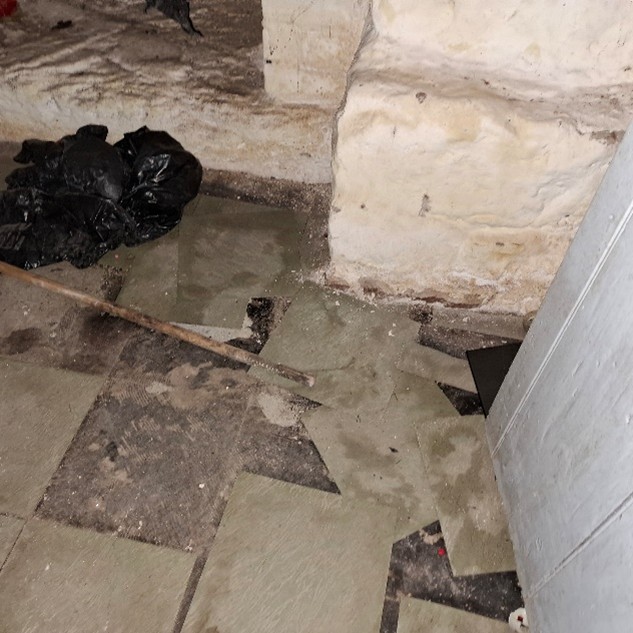
Badly deteriorated asbestos containing floor tiles and adhesive present in a basement in a school.
The Material Assessment score for this material is 1 + 2 + 0 + 1 = 4.
For the overall Priority Risk Assessment, the other factors outlined above need to be assessed.
• Normal Occupant Activity – Basement store – no main (0) or secondary (0) activity. Average: (0+0)/2 = 0 The score for Normal Occupant Activity is therefore 0.
• Likelihood of Disturbance – Large rooms (1), usually inaccessible (0), extent ≥ 50m² (3). Average: (1+0+3)/3 = 1.67, rounded up = 2 The score for Likelihood of Disturbance is therefore 2.
• Human Exposure Potential – No occupants (0), infrequent use (0), < 1 hour (0). Average: (0+0+0)/3 = 0 The score for Human Exposure Potential is therefore 0.
• Maintenance Activity – Medium disturbance to deteriorated tiles (2), infrequent maintenance (2). Average: (2+2)/2 = 2 The score for Maintenance Activity is therefore 2.
The overall Priority Risk Assessment of the material is therefore:
| Material Assessment | 4 | |
| Normal Occupant Activity | + | 0 |
| Likelihood of Disturbance | + | 2 |
| Human Exposure Potential | + | 0 |
| Maintenance Activity | + | 2 |
| Priority Risk Assessment Score | = | 8 |
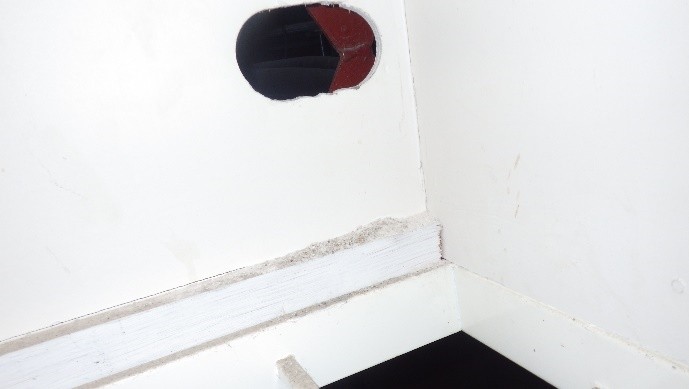
Asbestos Insulating Board skylight lining in a school IT Classroom, drilled into, with asbestos dust on the ledge beneath the hole.
The Material Assessment score for this material is 3 + 3 + 3 + 2 = 11.
For the overall Priority Risk Assessment, the other factors outlined above need to be assessed.
• Normal Occupant Activity – Lessons during the day (2) and before/after school clubs (2). Average: (2+2)/2 = 2 The score for Normal Occupant Activity is therefore 2.
• Likelihood of Disturbance – Large, well-ventilated room (1), dust routinely disturbed (3), small amount (0). Average: (1+3+0)/3 = 1.3, rounded up = 2 The score for Likelihood of Disturbance is therefore 2.
• Human Exposure Potential – 30+ children (3), used daily (3), > 6 hours (3). Average: (3+3+3)/3 = 3 The score for Human Exposure Potential is therefore 3.
• Maintenance Activity – Low disturbance maintenance (1), < once per year (1). Average: (1+1)/2 = 1 The score for Maintenance Activity is therefore 1.
The overall Priority Risk Assessment of the material is therefore:
| Material Assessment | 11 | |
| Normal Occupant Activity | + | 2 |
| Likelihood of Disturbance | + | 2 |
| Human Exposure Potential | + | 3 |
| Maintenance Activity | + | 1 |
| Priority Risk Assessment Score | = | 19 |
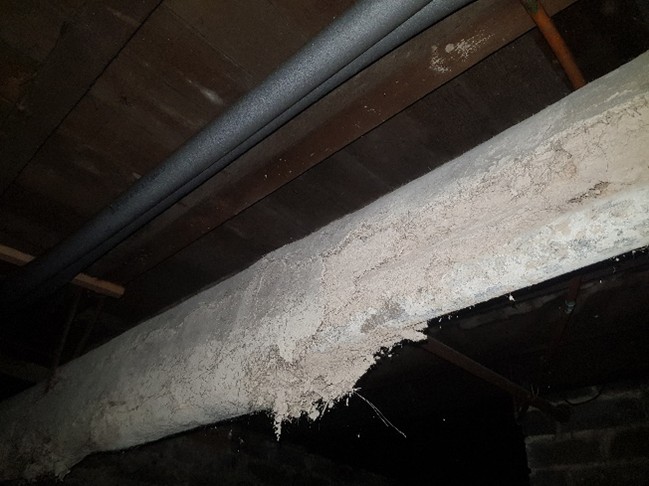
Asbestos lagging to pipework within a basement cellar in a pub.
The Material Assessment score for this material is 3 + 2 + 3 + 2 = 10.
For the overall Priority Risk Assessment, the other factors outlined above need to be assessed.
• Normal Occupant Activity – Periodic disturbance during general running (2) and private functions (2). Average: (2+2)/2 = 2 The score for Normal Occupant Activity is therefore 2.
• Likelihood of Disturbance – Confined space (3), easily disturbed (2), > 10m pipe run (2). Average: (3+2+2)/3 = 2.3, rounded up = 3 The score for Likelihood of Disturbance is therefore 3.
• Human Exposure Potential – 1–3 people (1), used daily (3), short periods only (0). Average: (1+3+0)/3 = 1.3, rounded up = 2 The score for Human Exposure Potential is therefore 2.
• Maintenance Activity – Medium disturbance (2), > once per year (2). Average: (2+2)/2 = 2 The score for Maintenance Activity is therefore 2.
The overall Priority Risk Assessment of the material is therefore:
| Material Assessment | 10 | |
| Normal Occupant Activity | + | 2 |
| Likelihood of Disturbance | + | 3 |
| Human Exposure Potential | + | 2 |
| Maintenance Activity | + | 2 |
| Priority Risk Assessment Score | = | 19 |
If we consider the two Priority Risk Assessment Scores above; i.e. that for the floor tiles in the school basement of 8, and that of the asbestos dust within the school classroom; of 19. It is clear to see that the asbestos instance which requires far greater priority of remedial works is the asbestos dust within the classroom.
Need help with your asbestos register?
Get straightforward, no-obligation advice from an experienced surveyor.
Contact UsFour Categories to Score
- Normal Occupant Activity
- Likelihood of Disturbance
- Human Exposure Potential
- Maintenance Activity
Each category score = average of its sub-categories, rounded up to nearest whole number.
Related Information
Browse more guidance articles
Knowledge Base